

South Africa Is More Digital Than You Think: The Numbers Behind Our Connected Nation

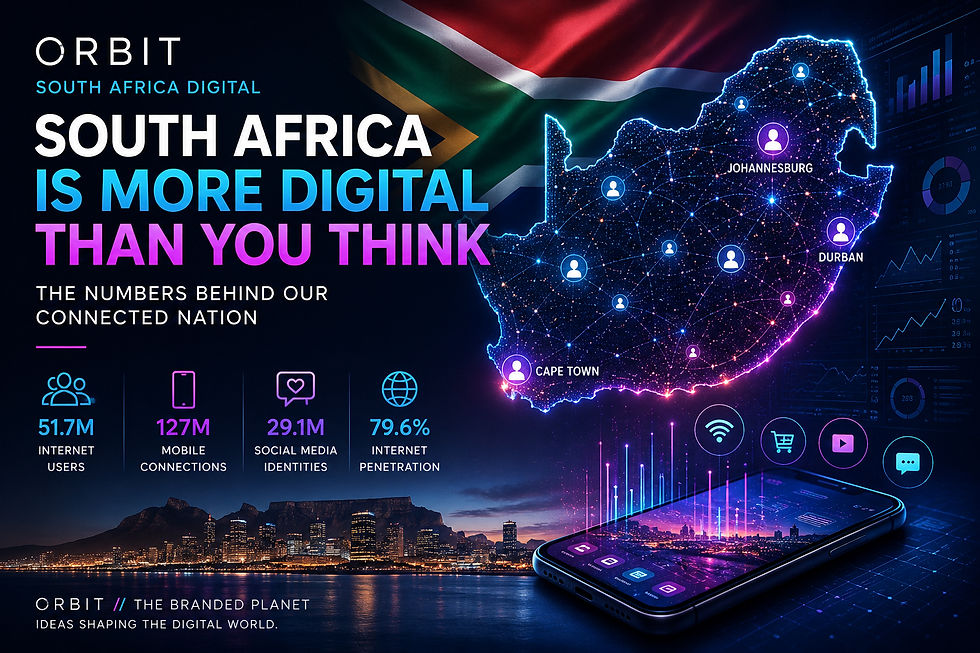
South Africa is more digital than you think and is connected on a scale that is easy to underestimate.
ORBIT // SOUTH AFRICA DIGITAL
South Africa is connected on a scale that is easy to underestimate.
By the end of 2025, South Africa had an estimated 51.7 million internet users, representing 79.6% of the population. There were also approximately 127 million active cellular mobile connections — almost twice the size of the country's population.
Those aren't simply impressive statistics. They represent a fundamental change in how South Africans communicate, shop, search, work, learn, entertain themselves and interact with businesses.
The South African economy is increasingly being lived through screens.
And for businesses, that changes everything.
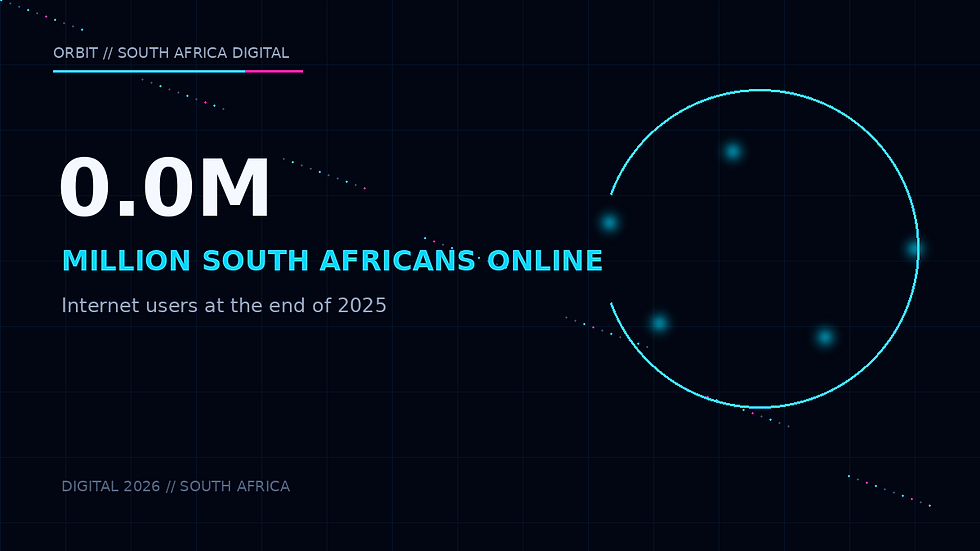
51.7 MILLION SOUTH AFRICANS ARE ONLINE
At the end of 2025, an estimated 51.7 million people in South Africa were using the internet, giving the country an internet penetration rate of approximately 79.6%.
Put another way: roughly four out of every five South Africans are now internet users.
That's a huge addressable digital audience.
Every day, millions of South Africans are searching for products, comparing prices, watching video, reading reviews, researching companies, communicating through messaging platforms and interacting with brands.
For businesses, the question is no longer whether their customers are online.
The question is:
Can those customers find you when they are?
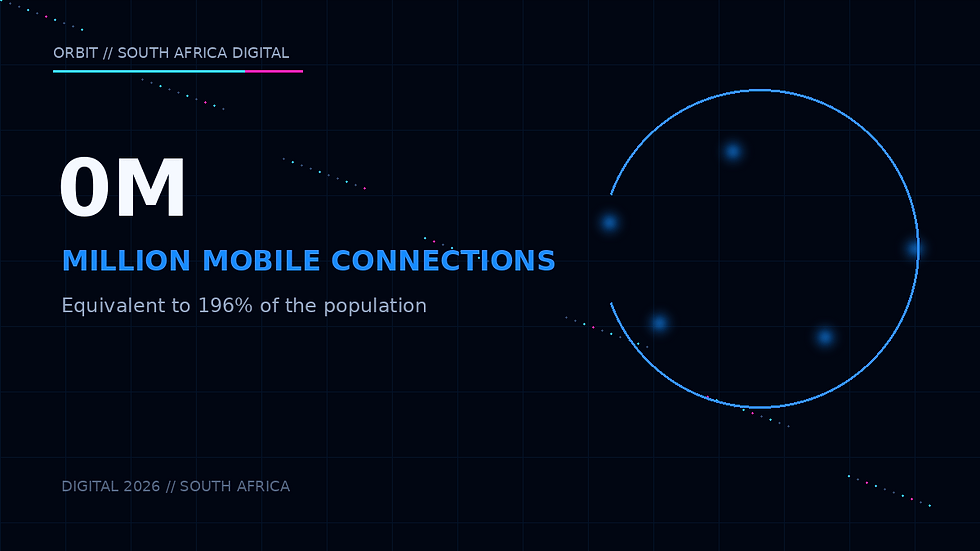
127 MILLION MOBILE CONNECTIONS
This is one of the statistics that really puts South Africa's digital landscape into perspective.
At the end of 2025 there were approximately 127 million cellular mobile connections active in South Africa — equivalent to roughly 196% of the country's population.
That doesn't mean everyone owns two phones. The figure includes multiple SIMs, business connections and other cellular connections.
But it demonstrates something extremely important:
South Africa is a mobile-first digital market.
For many consumers, the smartphone isn't a secondary way of accessing the internet.
It is the internet.
That has major implications for website design.
A beautiful desktop website that becomes slow, awkward or difficult to navigate on a phone isn't really a successful website in the South African market.
Mobile performance should influence everything from page speed and navigation to forms, checkout processes, WhatsApp integration and the way content is structured.
SOCIAL MEDIA IS A MASSIVE SOUTH AFRICAN MARKETPLACE
South Africa had approximately 29.1 million social-media user identities in October 2025.
Social media has evolved far beyond its original role as a place where people simply connect with friends.
It has become part entertainment platform, part search engine, part news source, part customer-service channel and part shopping centre.
For brands, this creates an interesting shift.
Your competition isn't simply another company selling the same thing.
You're competing for attention against everything else on the screen.
Friends, Creators, Breaking news, Entertainment, Sport, Memes, Video and thousands of other brands.
That's why posting more content isn't necessarily the answer.
Creating content that earns attention is.
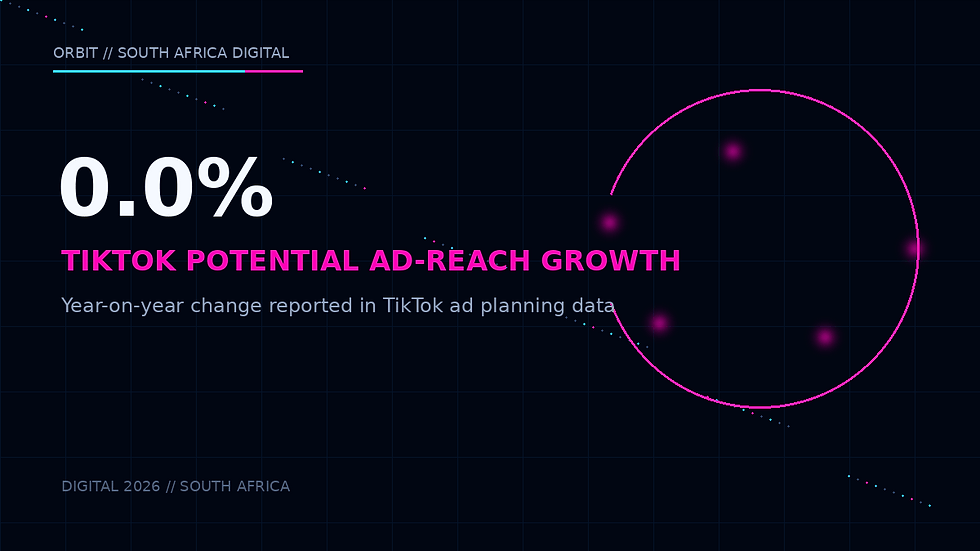
TIKTOK'S SOUTH AFRICAN GROWTH IS HARD TO IGNORE
One of the standout numbers is TikTok.
Data published in the Digital 2026 South Africa report indicates that TikTok's advertising tools showed a potential adult advertising audience of approximately 29.1 million users in South Africa in late 2025.
Its reported potential advertising reach increased by approximately 33.2% year-on-year.
That's significant.
Short-form video isn't a niche content format anymore. It has become a mainstream way people discover information, products, personalities and businesses.
It also changes how companies need to think about creative work.
Traditional advertising often begins with:
"What do we want to tell people?"
Short-form digital content requires another question first:
"Why would somebody stop scrolling to watch this?"
That's a very different creative problem.
YOUTUBE: 26.9 MILLION
YouTube's advertising resources indicated potential reach of approximately 26.9 million users in South Africa in late 2025.
Video therefore isn't simply another content option.
It is one of the largest digital communication channels available to South African businesses.
Tutorials, product demonstrations, explainers, interviews, case studies, Shorts and educational content can continue attracting audiences long after publication.
And unlike many traditional advertising formats, useful video content can simultaneously contribute to brand awareness, search visibility and customer education.
FACEBOOK: 27.9 MILLION
Despite constant predictions about the death of Facebook, the platform remains substantial in South Africa.
Meta's advertising resources indicated potential Facebook advertising reach of approximately 27.9 million users in late 2025.
The important lesson isn't that every business should suddenly spend money on Facebook.
It's that businesses should avoid making marketing decisions based purely on assumptions about which platforms are supposedly "dead" or fashionable.
Follow the audience and the data.
INSTAGRAM: 8.6 MILLION
Instagram's potential South African advertising audience stood at approximately 8.6 million users in late 2025.
More interestingly, its potential advertising reach increased by approximately 19.4% year-on-year.
For visually driven businesses — fashion, food, travel, automotive, property, design, beauty and lifestyle in particular — Instagram remains a significant discovery and brand-building environment.
But the platform has changed.
Highly polished static imagery now competes with Reels, creators, educational content and increasingly sophisticated recommendation algorithms.
The creative standard has moved.
LINKEDIN: 17 MILLION MEMBERS
For B2B businesses, perhaps one of the most interesting numbers is LinkedIn.
LinkedIn's advertising resources indicated approximately 17 million registered members in South Africa in late 2025. It's important to note that LinkedIn reports registered members rather than monthly active users, so this figure shouldn't be directly compared with the user figures reported by some other platforms.
Nevertheless, it illustrates the size of South Africa's professional digital network.
For companies selling expertise rather than consumer products, LinkedIn can be particularly powerful.
IT, Finance, Training, Consulting, Professional services, Technology, Recruitment.
Software, Business services.
In these markets, a relatively small number of highly relevant decision-makers can be more valuable than millions of general impressions.
SOUTH AFRICANS AREN'T JUST BROWSING. THEY'RE BUYING.
The next stage of South Africa's digital evolution isn't simply getting people connected.
It's what people do once they're connected.
Stitch's 2026 South African consumer report found that 62.5% of respondents shop online as much as or more than they shop in physical stores.
That's an important behavioural change.
The distinction between "online customer" and "offline customer" is becoming increasingly meaningless.
Someone may:
discover a product on TikTok,
Google the company,
check reviews,
visit its website,
compare a competitor,
message the company on WhatsApp,
visit a physical store,
and eventually purchase online.
That's one customer journey.
Modern marketing therefore can't operate as a collection of isolated channels.
Search, social, web, content and commerce are increasingly parts of the same system.
THE REAL BATTLE IS SEARCH
There is another consequence of having tens of millions of South Africans connected to the internet.
People can find alternatives almost instantly.
A customer doesn't necessarily need to know your competitor's name.
Google does.
Search for:
"IT training Cape Town."
"Digital marketing agency Cape Town."
"Accountant near me."
"Best security company Johannesburg."
"Web designer South Africa."
Within seconds, a consumer has options.That means your website isn't only competing on design. It is competing on:
1- visibility.
2- speed.
3- authority.
4- relevance.
5- trust.
6- user experience.
7- content.
And increasingly, how well search engines and AI systems understand what your business actually does.
AI IS ABOUT TO CHANGE DISCOVERY AGAIN
For more than two decades, the basic digital journey was relatively predictable.
A person wanted something. They searched Google. Google returned links.
They clicked one. Generative AI is beginning to complicate that model.
People can now ask systems questions instead:
"Which IT course should I take if I want to work in cybersecurity?"
"Compare these three products."
"Find a digital agency that specialises in SEO and web development."
"What's the best option for my budget?"
Increasingly, the interface between businesses and customers may not always be a conventional search-results page. It may be an AI-generated answer.
That makes structured websites, authoritative content, clear business information and technically sound SEO increasingly important. The next competition may not simply be:
Can Google find you?
It may become:
Does the digital ecosystem understand you?
SOUTH AFRICA//DIGITAL
So what does the connected South Africa look like?
51.7M internet users.
79.6% internet penetration.
127M cellular mobile connections.
29.1M social-media identities.
29.1M potential adult TikTok advertising audience.
27.9M potential Facebook advertising reach.
26.9M potential YouTube advertising reach.
17M LinkedIn registered members.
8.6M potential Instagram advertising reach.
Behind every one of those numbers is a person.
A search.
A message.
A video.
A purchase.
A question.
A decision.
An opportunity.
WHAT DOES THIS MEAN FOR SOUTH AFRICAN BUSINESS?
It means digital can no longer sit on the side of the business.
Your website, search visibility, social presence, data, content, automation and increasingly AI are becoming part of the infrastructure through which customers experience your company.
The businesses that gain an advantage won't necessarily be those using every new platform or chasing every trend.
They'll be the businesses that understand where their customers are, how their behaviour is changing and how technology can remove friction between attention and action.
Because South Africa isn't waiting to become digital.
It already is.
And the numbers are still moving.
South Africa is more digital than you think and is connected on a scale that is easy to underestimate.


Comments